+44 (0)20 8044 8461Get Prices & Availability
HERO: liveried cab passing the Bank of England, City of London. Minimum 2400px wide.
Locations

London taxi advertising

London is the home market for taxi advertising, and the reason the medium exists in the form it does. The city's licensed black cabs work the places brands most want to be — the City, the West End, Westminster, Canary Wharf, the airports and the arterial roads between them — for the whole of a working day, in traffic, at eye level.

Coverage

Taxi advertising in London.

A licensed cab is not fixed to a route or a site. The same vehicle can work the Square Mile at eight in the morning and Soho at eleven at night, which is why London campaigns tend to build reach faster than their fleet size suggests. It is also why coverage here is broad by nature: you are buying a share of the city rather than a set of postcodes.

Both formats run on both fleets in London. Supersides take both flanks of the cab and suit larger fleets built for frequency; Full Wraps take the whole exterior and suit smaller fleets built for standout. Every campaign includes interior Tip Seat advertising at no additional cost.

Business districts and landmarks
  • The City of London
  • The West End
  • Canary Wharf
  • Westminster
  • Mayfair
  • Shoreditch
  • Kensington and Chelsea
  • Heathrow and the airports
Why here

What makes London different.

The properties of the city itself that make taxi advertising work in London — rather than the properties of the format, which are the same everywhere.

The cab is part of the city

Very few vehicles are so bound up with a place that they appear on its postcards. A brand on the side of a London black cab is not renting space next to the city, it is riding on something the city already recognises — which is why the format reads as establishment rather than as media spend.

The largest licensed taxi fleet in the country

Around 14,500 licensed black taxis operate across London (Transport for London licensing data, 2025). That is what makes the medium work here in a way it does not elsewhere: enough vehicles in circulation for a campaign to be met repeatedly rather than once.

The audience is concentrated and valuable

London holds the densest concentration of head offices, agencies, financial institutions and international visitors in the country. A vehicle working the centre of it passes more decision-makers in a shift than most media plans reach in a week.

The traffic is the opportunity

Central London moves slowly, and slow traffic is good for advertising that lives on a vehicle. A cab held at a junction on Piccadilly is a stationary poster with a queue of people reading it, then it moves somewhere else and does it again.

One vehicle covers many audiences

The same cab can work the Square Mile in the morning, Mayfair over lunch, the West End in the evening and Heathrow overnight. In a city this segmented, that is a genuine advantage over any fixed site, which only ever reaches the people who pass it.

Journeys are long enough for the interior to matter

Cross-town journeys in London are rarely quick, which gives the interior tip seat panels a captive passenger with time on their hands. In a city with shorter average journeys, the interior would be a lesser part of the buy. Here it is not.

It photographs as London

A campaign shot on a black cab against a London backdrop is immediately legible worldwide. That image tends to outlive the campaign, appearing in pitch decks, press coverage and social posts long after the vinyl comes off.

Tell us what you are planning in London and we will size a campaign against your budget and your dates.

Get Prices & Availability
Area by area

London, district by district.

Where a campaign is weighted changes who sees it and how often. These are the areas that come up most, and what each one is actually good for.

The City of London

The financial district, and the most concentrated business audience in the country. Weekday traffic is dominated by people who work there, and cabs move through it constantly during business hours. Weekends are quiet by comparison, which is worth knowing when you are judging what a campaign will feel like on the ground.
The West End

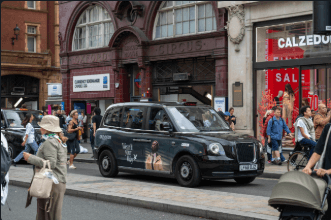
Retail, theatre and hospitality, with a mixed audience of workers, shoppers and visitors from late morning until late at night. Pedestrian density here is the point — Supersides sit in the eye line of pavements that are busy for most of the day, which is a different kind of value from the City’s repeat exposure.

Canary Wharf

A second financial centre with a distinct, self-contained character. Cabs work the approaches and the estate itself throughout the business day, and because the audience is concentrated in a relatively small footprint, campaigns tend to register there quickly.

Westminster and Whitehall

Government, policy, public affairs and the organisations that orbit them, plus a very heavy visitor flow around the landmarks. Useful for campaigns aimed at a policy audience, and for brands that want the most photographed backdrops in the city behind their vehicle.

Mayfair and Knightsbridge

Luxury retail, private wealth, hotels and galleries. A smaller audience than the City by volume, but a specific one, and the environment matters to brands where adjacency is part of the proposition.

Shoreditch and the eastern fringe

Technology, creative agencies and a younger professional audience, with an evening economy that keeps cabs working late. Often paired with the City on a campaign that wants both the institution and the challenger side of the same audience.

Heathrow and the airport routes

Long journeys, international arrivals and business travellers. The airport runs are where the interior tip seat panels do their best work, simply because the passenger is in the vehicle for a considerable time with nothing else to look at.

Formats

Both formats run in London.

Supersides take both flanks of the cab; a Full Wrap takes the whole exterior. Interior Tip Seat advertising is included with either.

Superside advertising panel fitted to the flank of a premium electric black cab on a busy London shopping street

Taxi Supersides

Large printed panels on both flanks of the cab, read at pavement eye level across the busiest streets in the city.

About Taxi Supersides
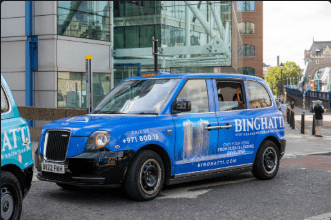
Premium electric black cab wrapped in a full vinyl livery, photographed on a London street

Taxi Full Wraps

The entire exterior of the cab wrapped in your creative — the highest-impact presence available on a licensed taxi.

About Taxi Full Wraps
Audience

Who the campaign reaches.

London taxi passengers skew towards business travellers, professionals and visitors — people making or influencing spending decisions, and often doing so on expenses. Outside the cab, the audience is everyone the vehicle passes: pedestrians on the busiest retail streets in the country, cyclists, bus passengers and other drivers.

Typical campaigns

What brands buy in London.

A cross-section of the campaign shapes that come up most often, and the audiences behind them.

  • Financial and professional services targeting the City and Canary Wharf
  • Luxury, retail and hospitality brands reaching West End and Mayfair footfall
  • Technology and B2B launches timed to a conference or trading period
  • Recruitment campaigns that need to be seen by a specific professional audience
  • International brands establishing UK presence ahead of a market entry
Included · no additional cost

Your campaign doesn’t stop outside the cab.

Every Superside and Full Wrap campaign includes interior Tip Seat advertising at no additional cost, giving your brand additional visibility to passengers during their journey.

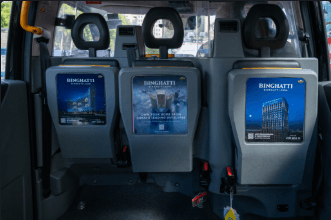
The exterior creates the reach. The interior does something different: it puts your message in front of a seated passenger with time on their hands, in the most captive environment outdoor advertising has. Premium Black Cabs carry three tip seat panels and Classic Black Cabs carry two, so the fleet you choose changes how much interior inventory the campaign gets.

Three illuminated tip seat advertising panels on the fold-down seats inside a premium electric black cab
Premium Black Cab interior · three panels
Two tip seat advertising panels on the fold-down seats inside a classic London black cab
Classic Black Cab interior · two panels
Planning

Planning a campaign in London.

The levers that actually change a local campaign, and the honest limits on each of them.

The fleet works the whole city

This is the honest position, and it matters: a standard advertising campaign runs on working London taxis, and where any given cab goes on any given day is not something we or you direct. Coverage is city-wide and organic rather than targeted, and we cannot guarantee or weight a fleet by borough or by driver shift pattern.

Buy reach, not a postcode

That makes taxi a reach-and-frequency medium rather than a targeting one. It works because the vehicles move through the places that matter anyway — the City, the West End, the stations, the airports — over the course of a working day. If a campaign genuinely must hit one postcode and nothing else, taxi advertising is the wrong format and we will tell you so.

When you need control, hire the taxi

For activity that has to be in a specific place at a specific time — a launch, an activation, a shoot — private taxi hire is the right tool. There we provide the taxi and the driver and the vehicle follows an activation plan agreed in advance, which is a different arrangement from fleet advertising entirely.

Availability is the real constraint

A cab carrying one campaign cannot carry another, so London inventory is genuinely finite for a given set of dates. Campaigns tied to a fixed launch need more notice than always-on runs that can start when the vehicles are ready.

Frequently asked

Taxi advertising in London, answered.

Can a London taxi advertising campaign be targeted to specific areas?

Not on a standard campaign. Advertising taxis are part of the working London fleet, and we cannot guarantee or weight a fleet by borough or by driver shift pattern — the vehicles go where the working day takes them. What you are buying is broad, organic coverage of the city rather than a targeted zone. If your activity genuinely needs taxis in a particular place at a particular time, that is private taxi hire, where the vehicle and driver follow a plan agreed in advance.

Which London areas do the cabs cover?

Greater London, including the City, the West End, Westminster, Canary Wharf, Kensington and Chelsea, Shoreditch and the airport routes. Because cabs move continuously through the day, a campaign is seen across the whole city rather than at fixed sites.

Are both Premium and Classic Black Cabs available in London?

Yes. Both Supersides and Full Wraps run on the Premium Black Cab and the Classic Black Cab, and a campaign can use either fleet or a combination of the two, depending on objectives and availability.

Is Tip Seat advertising included on London campaigns?

Yes. Interior Tip Seat advertising is included at no additional cost with every Superside and Full Wrap campaign in London. Premium Black Cabs carry three tip seat panels and Classic Black Cabs carry two.

Why advertise on London taxis rather than London buses or billboards?

They do different jobs. A billboard owns one location and waits; a bus follows a fixed route; a taxi moves through the whole city and changes audience through the day. Taxi also carries an association with London itself that neither of the others does, and it puts an interior panel in front of a seated passenger as part of the same buy. Many plans use taxi alongside other outdoor formats rather than instead of them.

Does taxi advertising work outside central London?

Yes, though it works differently. Licensed cabs cover Greater London, but demand and dwell time are concentrated towards the centre and the airport routes, so a campaign weighted outward trades density for spread. If your audience is in a specific outer borough, tell us — we will be straight about whether taxi is the right way to reach them.

When is the best time to run a London taxi campaign?

It depends more on your own calendar than on the city’s. What does matter is that inventory is finite and a cab carrying one campaign cannot carry another, so the constraint on a specific set of dates is usually availability rather than budget. Bring dates early and we will tell you what the fleet can actually support.

Next step

Get prices for a campaign in London.

Tell us the city, the format you are considering, your budget and your dates. You will get formats, fleet availability and an indicative rate — from a person, not a portal.